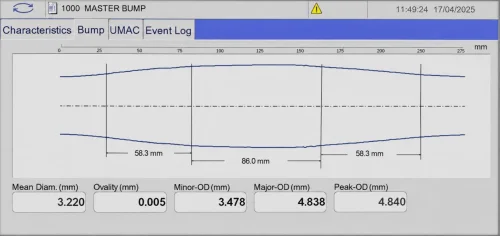
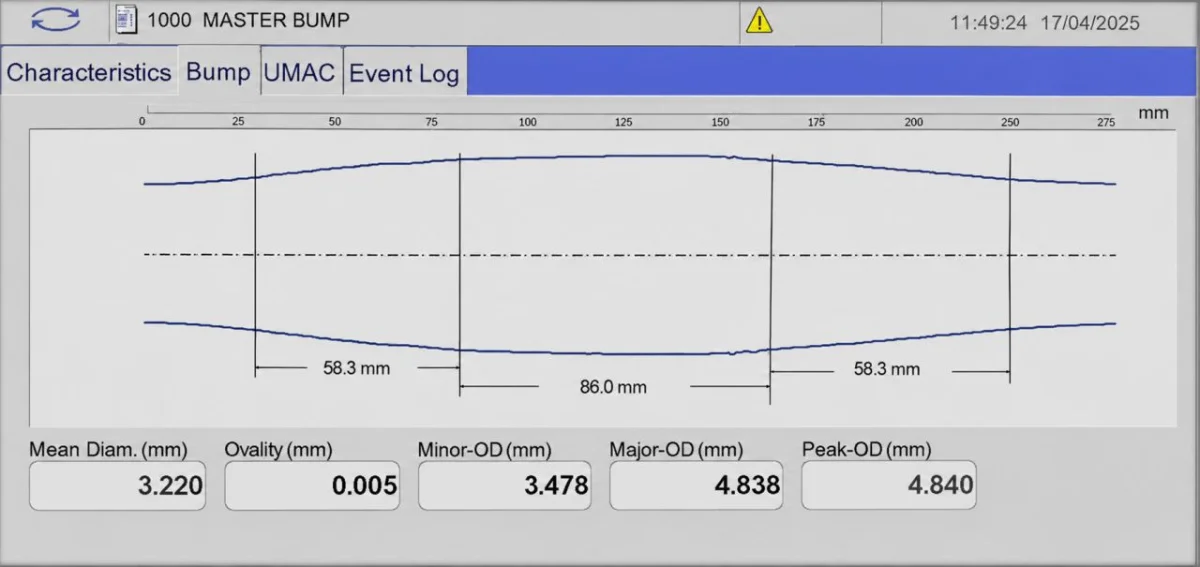
In medical extrusion, the terms bump tubing and taper tubing are often used to describe tubing with variable dimensions along its length.
Depending on the application, the tubing may feature:
- Variable outer diameter (OD)
- Variable inner diameter (ID)
- Variable wall thickness
- Smooth dimensional transitions
Although the two terms are sometimes used interchangeably, they can describe slightly different geometries: Bump tubing generally refers to tubing with localized dimensional enlargements or reductions. Taper tubing usually indicates a gradual and continuous dimensional transition from one section to another. Both technologies are widely used in advanced catheter manufacturing and minimally invasive medical devices.
Typical applications include:
- Balloon catheters
- Delivery systems
- Drainage catheters
- Introducer systems
- Multi-functional catheter shafts
The ability to create variable geometries directly during extrusion helps reduce secondary operations and improve product consistency.
How Bump Tubing and Taper Tubing Extrusion Works
The extrusion of bump tubing and taper tubing requires extremely precise synchronization between multiple machine parameters. During production, the extrusion line dynamically controls:
- Puller speed
- Extruder output
- Internal air pressure
- Cooling conditions
- Line speed synchronization
By continuously adjusting these parameters, the system can create:
- Localized diameter increases
- Controlled diameter reductions
- Progressive tapers
- Variable wall thickness profiles
The most critical aspect is maintaining stable dimensions while the tubing geometry changes continuously. For this reason, dedicated medical extrusion lines require:
- High-speed control systems
- Stable melt pressure
- Precise servo motor synchronization
- Advanced closed-loop diameter control
Main Challenges in Bump and Taper Tubing Extrusion
Producing high-quality variable-dimension tubing is significantly more complex than standard constant-diameter extrusion. Several process variables must remain perfectly controlled throughout production.
Transition Precision
One of the most critical factors is the accuracy of the transition zone between different tubing dimensions. Poor synchronization may generate:
- Irregular profiles
- Wall thickness instability
- Ovality
- Stress concentration points
- Mechanical weak areas
In medical applications, smooth and repeatable transitions are essential to guarantee device performance.
Tight Tolerances
Medical tubing often requires dimensional tolerances within a few hundredths of a millimeter. Maintaining these tolerances during continuous geometry variation requires:
- Stable material feeding
- Constant extrusion pressure
- Accurate haul-off control
- Precise cooling management
Even small process variations can affect the final catheter performance.
Polymer Behavior
Different medical-grade polymers behave differently during dimensional transitions. Materials such as:
can react differently in terms of:
- Elasticity
- Shrinkage
- Melt stability
- Shape memory
Extrusion parameters must therefore be optimized according to the specific material and tubing design.
Typical Medical Applications
Bump tubing and taper tubing are commonly used when different sections of a catheter require different mechanical properties.
For example:
- Flexible distal sections
- Stiffer proximal shafts
- Balloon transition areas
- Bonding sections
- Reinforced zones
This technology helps optimize:
- Flexibility
- Pushability
- Torque transmission
- Kink resistance
- Flow performance
while reducing additional assembly operations.
Why Process Stability Is Essential
In bump tubing and taper tubing extrusion, repeatability is fundamental. Modern medical extrusion lines therefore integrate:
- Laser diameter gauges
- Closed-loop automatic control systems
- Servo-driven haul-off units
- Digital recipe management
- Real-time production monitoring
A stable process helps manufacturers reduce:
- Scrap rates
- Setup times
- Operator dependency
- Product variability
while improving production efficiency and product quality.
Tecno System Approach to Bump and Taper Tubing Extrusion
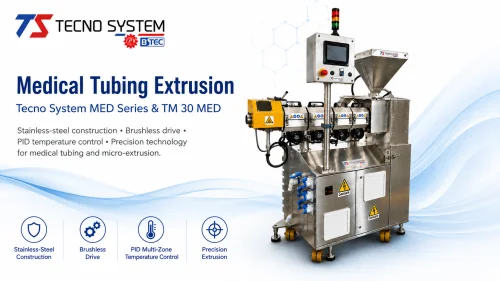
At Tecno System, extrusion lines for bump tubing and taper tubing are designed to ensure high precision, repeatability and process stability for advanced medical applications. Our solutions can be configured with:
- High-precision extrusion control
- Vector-driven extrusion systems
- Advanced synchronization software
- Customized cooling technologies
- Inline measurement systems
- Complete turnkey integration
Each project is developed according to the required tubing geometry, material characteristics and customer production targets.
Conclusion
Bump tubing and taper tubing extrusion represent some of the most advanced processes in medical tubing manufacturing. Producing variable-geometry tubing with high dimensional accuracy requires deep process expertise, advanced control technology and highly stable extrusion systems. As catheter designs continue becoming more sophisticated, bump tubing and taper tubing technologies will play an increasingly important role in improving medical device performance and manufacturing efficiency.

 en
en